Headlines
India's strategic autonomy: Partnering widely, disagreeing politely and choosing without apology
New Delhi, Dec 8
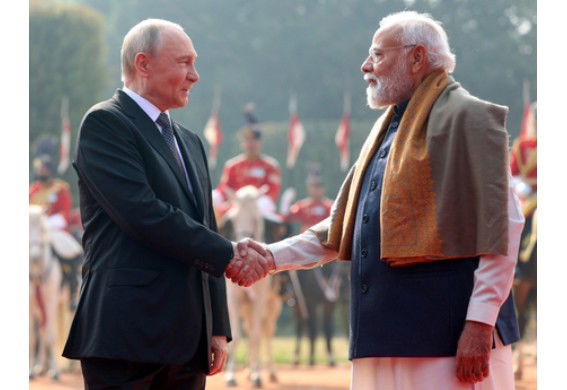
The camaraderie shared between Russian President Vladimir Putin and Prime Minister Narendra Modi during the former's visit to India last week was neither a challenge to the West, nor a throwback to Cold War certainties, but a signal that New Delhi's strategic autonomy is a lived principle -- partnering widely, disagreeing politely, and choosing without apology, a report said on Monday.
It added that their warm hug distilled a hard truth the world has struggled to accept — that India no longer adapts to geopolitical currents -- it shapes them.
"When Prime Minister Narendra Modi broke established protocol on the evening of December 4, 2025, to personally receive Russian President Vladimir Putin on the tarmac of Palam air base, the gesture lasted a full eight seconds on live television. Eight seconds is an eternity in diplomacy. It was long enough for the world to register that India had just detonated a quiet thermonuclear device in the heart of the Western sanctions regime. The hug was warm, unhurried, and entirely deliberate. It was also the loudest silence Washington and Brussels have heard in years," wrote former Indian diplomat Sanjay Kumar Verma in India Narrative.
"The choreography that followed was pure theatre with steel beneath the velvet. An Indian-made vehicle ferried the two leaders from the tarmac. A private dinner at Hyderabad House stretched well into the night. President Droupadi Murmu toasted 'eternal friendship' under the chandeliers of Rashtrapati Bhavan. The joint statement spoke of a $100 billion trade target by 2030, nuclear reactors at Kudankulam, joint AI research, and Arctic shipping through the warming Arctic, amongst many other initiatives. Nothing revolutionary on paper. Everything revolutionary in context," Verma, the current Chairperson of the Research and Information System for Developing Countries (RIS), stated.
According to the report, rarely has a single diplomatic visit sparked a kaleidoscope of official statements, leaked briefings, anonymous quotes, and social-media frenzy, with the world reacting in real time.
It emphasised that policy implications for the West are stark -- threats fail, tariffs backfire, and moral lectures elicit nothing more than eye-rolls.
"If Washington wants India's help managing China (still a near-unanimous bipartisan goal), it will have to treat India as an equal. That means accepting defence-industrial ties with Russia, energy ties with whoever offers the cheapest barrel, and technology partnerships chosen on merit, not ideology. Brussels faces the same choice, or it will watch India glide toward an expanded BRICS where its vote carries more weight than the entire European Union combined," the report noted.