Washington, Dec 9
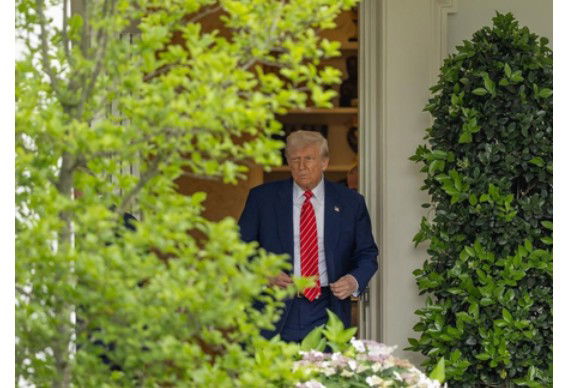
Young American voters have turned sharply against President Donald Trump and are deeply sceptical of his flagship One Big Beautiful Bill Act (OBBBA), even as they show more traditional views on gender roles and more negative attitudes towards Israel than older generations, according to a new Yale Youth Poll released on Monday.
One of the starkest findings is the collapse in Trump’s standing among young voters. The poll notes that the then Vice President Kamala Harris won the 2024 vote of respondents aged 18–22, 23–29, and 30–34 by 3, 8, and 12 percentage points, respectively.
Those same groups now disapprove of President Trump’s job performance by 30, 34 and 36 points. This marks a sharp reversal from the project’s spring 2025 survey, which had found that voters aged 18–21 “narrowly approved of Trump’s job performance, while voters 22–29 narrowly disapproved.”
Democrats also hold commanding leads on the congressional generic ballot among younger Americans, with advantages of 15, 16, and 20 percentage points among 18–22-year-olds, 23–29-year-olds, and 30–34-year-olds, respectively. Republicans, by contrast, lead by 7 points among 45–64 year-olds, and voters aged 65 and above are split.
There is near-unanimous frustration with the current direction of the country, the polls reveal.
Just 4 per cent of respondents believe that “no real changes are needed” in America, compared to 46 per cent who want “a return to basic stability” and another 46 per cent who would like “a major change and a shock to the system.” Young voters are especially likely to favour “a major change and a shock to the system.”
Yet the electorate is evenly divided on which party embodies change, with 29 per cent choosing the Democratic Party, 29 per cent the Republican Party, 22 per cent neither and 13 per cent both.
The youngest cohort is also more ideologically polarised. The poll finds that 47 per cent of 18–22-year-olds and 45 per cent of 23–29-year-olds identify as liberal, higher than in older age groups. At the same time, 40 per cent of 18–22 year-olds and 38 per cent of 23–29 year-olds call themselves conservative, leaving relatively fewer moderates among young Americans.
In 2028, Republican voters currently favour Vice President JD Vance, who wins 51 per cent support in a primary field without Trump, followed by Donald Trump Jr. (8 per cent), Florida Governor Ron DeSantis (6 per cent), former UN Ambassador Nikki Haley (5 per cent) and Secretary of State Marco Rubio (5 per cent). Vance “has a wide lead across all age groups,” and in a separate electability test, Republicans rate DeSantis (79 per cent) and Vance (75 per cent) as the strongest general-election candidates.
However, when President Trump is hypothetically allowed to run again, “Trump enjoys 50 per cent support, followed by Vance at 19 per cent and all others under 5 per cent.”
Democratic voters, meanwhile, put California Governor Gavin Newsom ahead in the 2028 primary with 25 per cent support, followed by former Vice President Kamala Harris (18 per cent), Representative Alexandria Ocasio-Cortez (16 per cent) and former transportation secretary Pete Buttigieg (14 per cent), with all others under 5 per cent.
Strategically, Republicans and Democrats diverge on how to approach future elections. A majority of Republican respondents (55 per cent) believe the GOP should focus on “energising and turning out their base,” compared to 25 per cent who want the party to moderate and 20 per cent who favour keeping the 2024 strategy.
Among Democrats, 49 per cent say their party should moderate, 45 per cent want to prioritise turning out the base, and just 6 per cent want to repeat the 2024 playbook. The Yale team calls this “a noticeable shift” from its spring poll, when 59 per cent of Democrats said the party should move left and 39 per cent said it should move to the centre. Younger Democrats under 35 mostly favour emphasising the base, while older Democrats lean towards moderation.
The One Big Beautiful Bill Act, closely associated with Trump in voters’ minds, is deeply unpopular. When asked what comes to mind when thinking of OBBBA, respondents most often say “Trump” and “tax,” along with other terms such as “rich,” “cuts,” “taxes”, and a string of negative descriptors including “stupid,” “bad,” “terrible,” “horrible”, and “corruption.”
When asked which groups would benefit most, 33 per cent of voters say billionaires and 20 per cent say people earning over $200,000 a year. Only 16 per cent combined believe the middle class, the working class, or the poor would benefit most.